How it is calculated
Every material has a thermal strain curve ε(T): the change of length per unit length from the reference temperature 20 °C (ISO 1, the temperature at which fits and drawings are specified). Above 20 °C the strain is the mean coefficient α (20–100 °C) times the temperature difference. Below 20 °C the calculator uses measured low-temperature contraction from NIST where it exists, because α falls as metals get colder: steel cooled in liquid nitrogen shrinks about 0.19 %, not the 0.25 % that α × ΔT predicts.
Strain ε(T) = α · (T − 20 °C) T ≥ 20 °C (mean α 20–100 °C)
ε(T) = α·(T−20)·α_EC(T)/α_EC(100) T > 100 °C, steels and aluminium (Eurocode strain curve shape)
ε(T) = NIST integral contraction table T < 20 °C (steel, stainless, Al, Cu, Ti, Invar, PTFE, PA)
Length change L2 = L · (1 + ε(T2)) / (1 + ε(T1)) ≈ L · α · (T2 − T1)
Area, volume A2/A = (1 + Δε)², V2/V = (1 + Δε)³ ≈ 2αΔT and 3αΔT
Fully constrained σ = E · Δε F = σ · A (compressive when heated)
Fit at temperature c(T) = c20 + d · [ ε_outer(T_outer) − ε_inner(T_inner) ] c = clearance, −c = interference
Shrink fit ε_hub(T_hub) − ε_shaft(T_shaft) = (i_max + s) / d s = assembly clearance
same material, ΔT = (i_max + s) / (α · d) shaft at room temperature
shaft at room
Typical cases
- Aluminium housing, steel bearing: aluminium grows twice as fast as bearing steel. A K7 or M7 housing bore that grips the outer ring at 20 °C can turn into a clearance at 70 – 90 °C, and the ring starts to creep. Use the "Fit at temp." mode with the housing and ring temperatures from operation; aluminium housings often get a tighter bore (N7, P7) for this reason.
- Steel shaft in a bronze bush: bronze grows faster than steel, so warming both parts opens the running clearance; a hot shaft in a cold bush (start-up) closes it.
- Pipes and rails between fixed points: a steel bar held at both ends sees about 2.5 MPa per kelvin. 80 K of heating already gives about 200 MPa, more than half the yield of S355, and long slender members buckle long before that.
Temperature limits used for shrink fitting
Rolling bearings: 120 °C (NSK: "do not heat bearings above 120 °C"; SKF: never above 125 °C unless the maker says otherwise; SKF finds 80 – 90 °C above the shaft is normally enough). Sealed or greased bearings can have a lower limit – check the maker. Hardened and case-hardened parts: 150 °C, as they are usually tempered at 150 – 200 °C and lose hardness if heated beyond their tempering temperature. Age-hardened aluminium (T6): 150 °C, since artificial ageing runs at about 160 – 180 °C and longer heating above it over-ages the alloy. Plain carbon and quenched-and-tempered steel: 350 °C (scale, temper colours). Oil baths: stay well below the flash point of the oil (mineral oils roughly 200 – 250 °C, see the data sheet); above about 150 °C use an oven or an induction heater, never an open flame on finished parts.
Material data: steels, aluminium, copper alloys and titanium from the ASM Ready Reference: Thermal Properties of Metals and the alloy standards (EN 10025, EN 10083, EN 755, EN 1561, EN 1982); Invar from Aperam/Carpenter data; plastics from manufacturer sheets (typical, not guaranteed); soda-lime glass EN 572-1; borosilicate ISO 3585; concrete EN 1992-1-1 (α 10·10⁻⁶ /K, C30/37 Ecm 33 GPa, fctm 2.9 MPa). Low-temperature contraction: NIST cryogenic material property fits for 304 stainless, 6061-T6, OFHC copper, Ti-6Al-4V, Fe-3.25Ni steel (within 2 % of iron in NBS Monograph 29), Invar, PTFE and nylon.
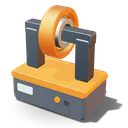 Induction bearing heater
 Infrared thermometer